Disimula – Features
Themes and variants, fair deck dealing, a card editor, printable QR cards, achievements, online rooms and admin panels.
Missions: themes, variants and private sets
- Themes. Six predefined themes ship with the app, 24 missions each, seeded at startup from
predefined.jsonwhen missing. Each theme shows organizers a description and an example mission that is never dealt, so they can judge the tone without spoiling the deck. - Variants. A theme holds independent sets of missions, each with one difficulty (easy, medium, hard). A new variant lets a group replay a theme with missions nobody has seen. A theme never holds the same mission twice across its variants, so several variants can share one game.
- Duplicate detection. Missions are compared by a fingerprint: letters and digits only,
ignoring case, accents and punctuation (
MissionText.fingerprint). - Private sets. An organizer can write their own missions ("My missions"), by hand or with AI, and deal them alone or mixed with themes. A private set is modelled as a theme with an owner and a single variant, so the dealer treats it like any other. Its endpoints answer 404 to anyone else, admins included; the admin panels only show its name and counts, never its missions.
- Three languages. Everybody's themes exist in Spanish, English and Italian (missions stored once per language). A private set is written in one language and can only be dealt in games of that language.
Dealing the decks
DeckDealer is a small, heavily tested piece of domain logic:
- every player gets the same number of missions, none repeated within a deck;
- no two players get the same set;
- each deck takes the missions dealt the fewest times so far, so missions are shared between players only when the chosen variants hold fewer missions than cards are needed, and then evenly;
- online games are stricter: everybody sees completed missions, so every card must be different
(
422 not_enough_missionsotherwise).
A card keeps a copy of its mission's text, so editing a theme later never changes a game in play.
Card editor
Each game has its own look:
- Front: background, ink and accent colours and three texts (title, label, last line).
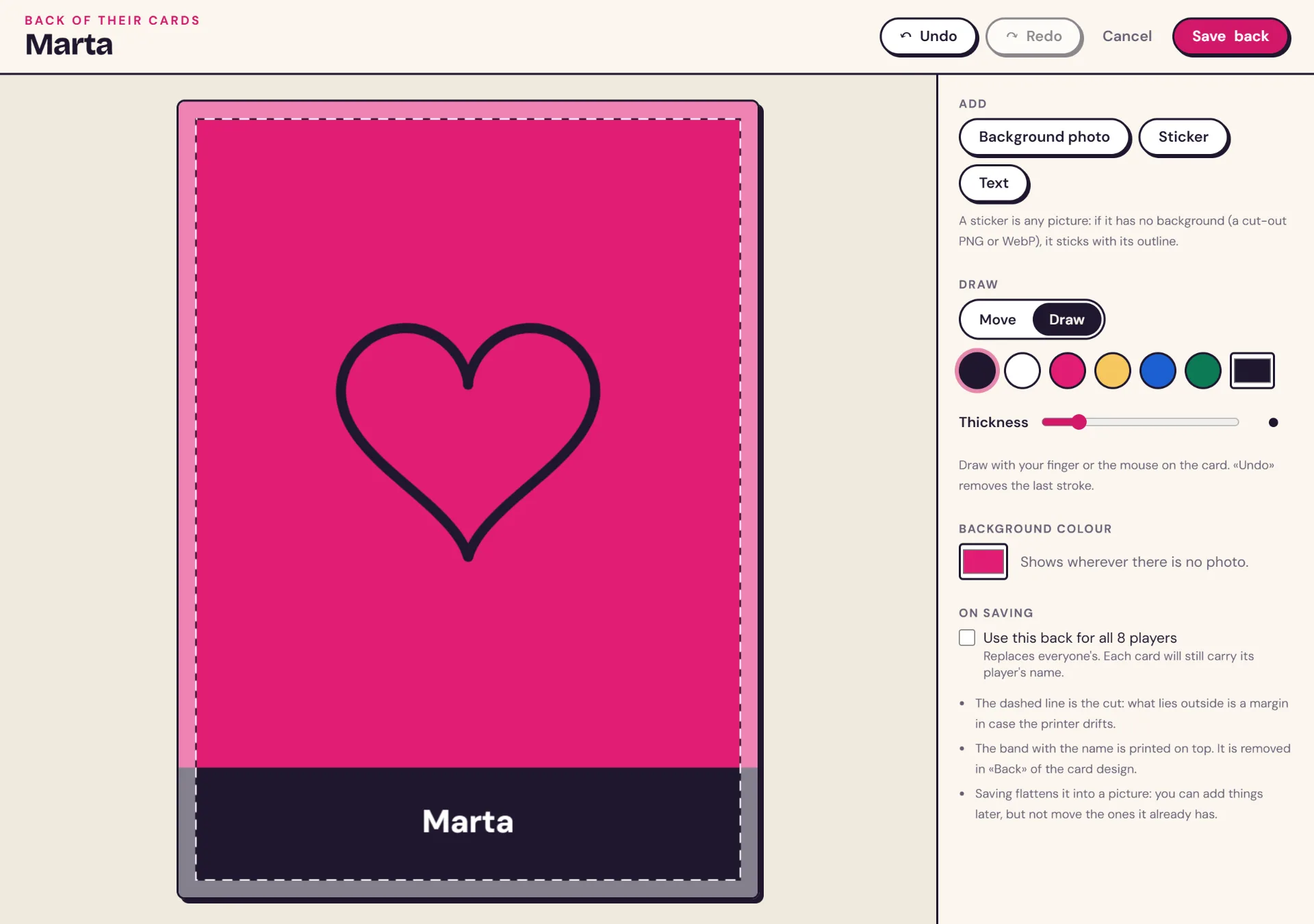
- Back, per player: a photo filling the card, cut-out pictures stacked as stickers, text over it and freehand drawing, with undo. It is drawn on a canvas the size of the printed back, bleed included, then flattened to a JPEG.
- Photos are shrunk in the browser first (which also applies the camera's rotation), then redrawn server-side as plain JPEGs of at most 1100 px: JPEG or PNG only, 2 MB max, no metadata kept.
Printable cards (offline games)
PdfCardSheetRenderer (PDFBox + ZXing) produces an A4 PDF of poker-size cards, 63 × 88 mm, nine per
page, to print double-sided:
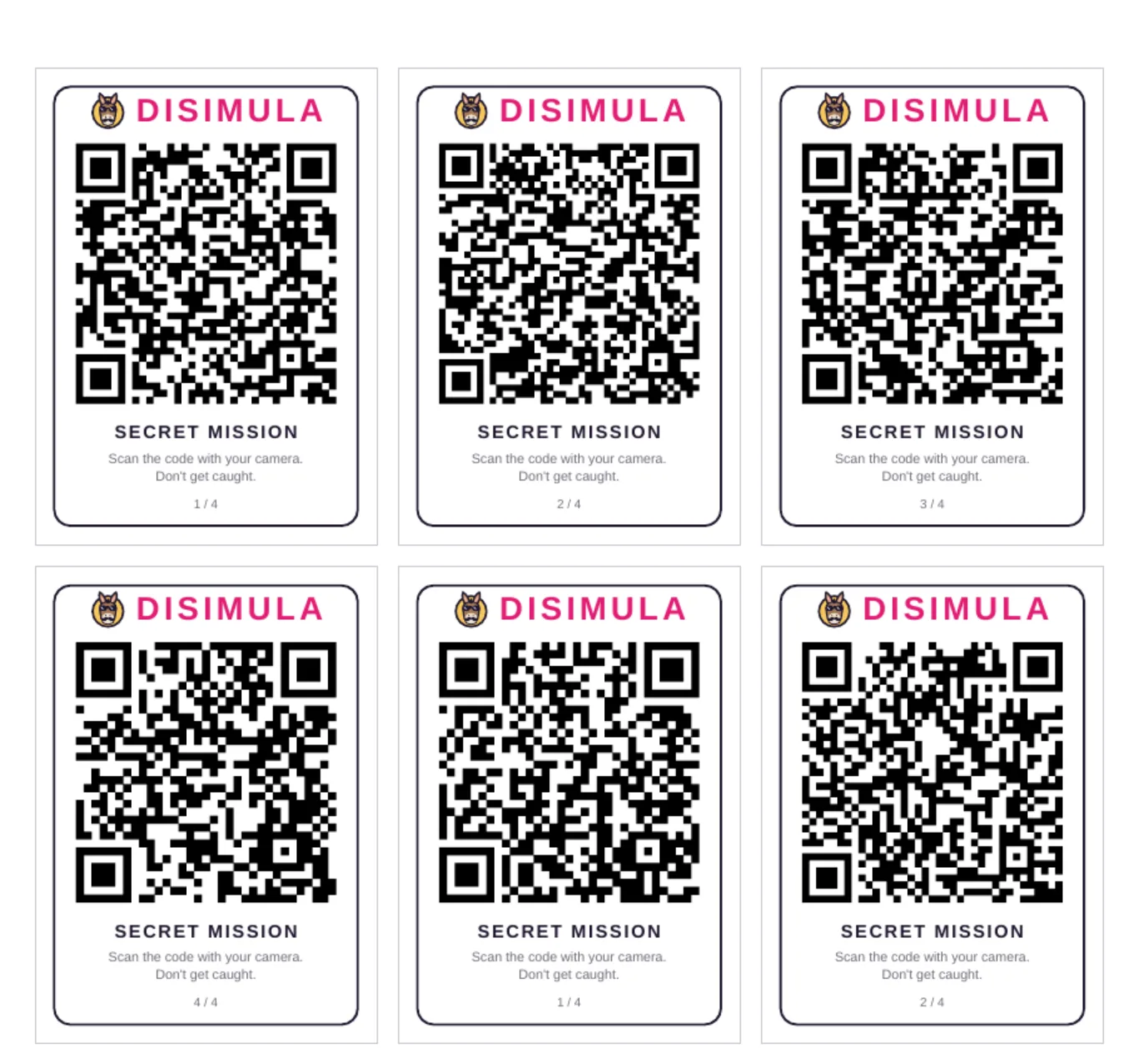
- odd pages are fronts: the mission as a QR code (UTF-8, error correction M, drawn as vectors) on a white panel so it reads on any background;
- even pages are backs with mirrored columns, for printing flipped on the long edge;
- no printer lands both sides exactly, so only the fronts carry cut lines and each back is painted 2 mm past its card on every side: cut along the fronts and the back still covers the card.
The QR code is the whole trick of the offline game: the mission is readable with any phone camera, but not at a glance by someone looking over your shoulder.
Achievements
The organizer picks achievement cards from a catalog; they print after the missions and are handed out at the end to whoever meets their condition. A secret achievement only prints its title; the condition is inside a QR code read at the end, and no API response ever carries it (the organizer may be playing). Each open achievement has its own line-drawn medal; all secret ones share a padlock, so the picture gives nothing away.
Online games
The organizer opens a room and shares its code, link or QR code. Then:
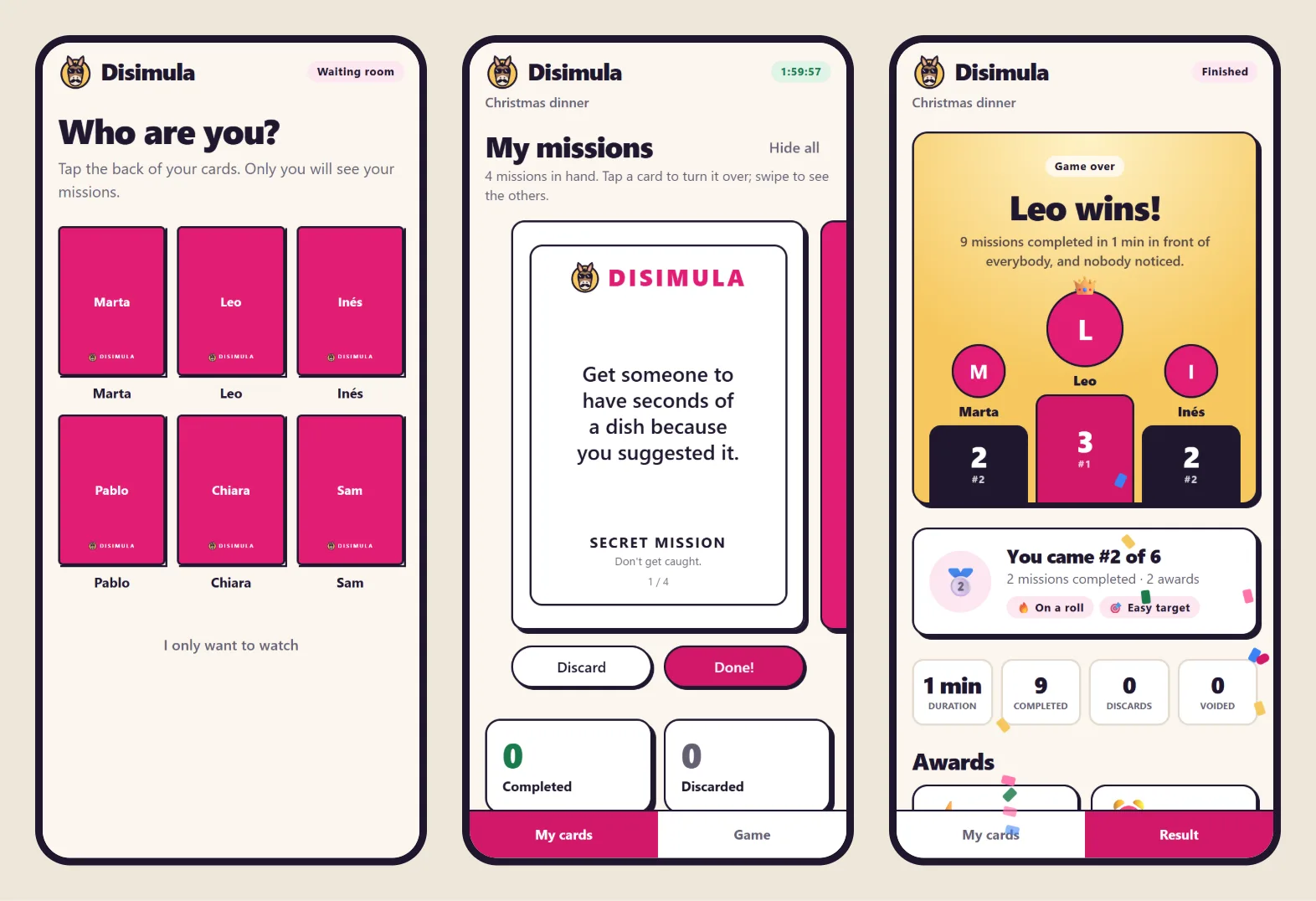
- Each player picks their profile by the back of their cards. The phone that picks one holds it.
- The organizer starts the clock (duration, discards per player) from their own link, whose key lives
after the
#so browsers never send it anywhere. - A player sees their missions as face-down cards. "Completed!" scores a point and reveals it to everybody (undoable for 2 minutes); "Discard" draws a new one from the reserve.
- The organizer rules: rule a mission out with a reason, let it stand, change the time, release a profile. Players can ask for a mission to be ruled out; everybody sees it was asked, only the organizer sees who asked and why.
- When time is up everything is revealed and the board becomes a summary: winner, podium, numbers of the game and awards (first mission, last one, who was fooled most...).
The home backend collects the result the next time the organizer opens the game.
Admin panels
- Usage: games per week, top organizers, packs, generations, uptime, memory and database size. Counts only, never a mission.
- AI: every request with its prompts, outcome and the evaluator's scores; usage by model, audience, difficulty and language; the themes and words asked for most.
- User explorer: one user's private sets, games, payments, refunds and AI requests.
- Billing: sales, refunds and Paddle notifications in paged, filterable lists; tier limits, settings, promo codes, manual passes and subscriptions.
Internationalization
The app, the landing page and the online rooms speak Spanish, English and Italian. What a game shows (themes, cards, PDF texts, achievements, the room) follows the game's language, chosen at creation, not the app's. API errors come back with stable codes and are translated in the browser; the prompt guard is the one exception, which answers in the requester's language with the reason.